"The Magician – Mercury and the Moment I Was Seen" takes you on a journey of self-discovery and transformation. Through the symbolic lens of Mercury, it uncovers hidden truths and illuminates the path to personal enlightenment. A powerful tale of unseen moments that shape who we truly are.
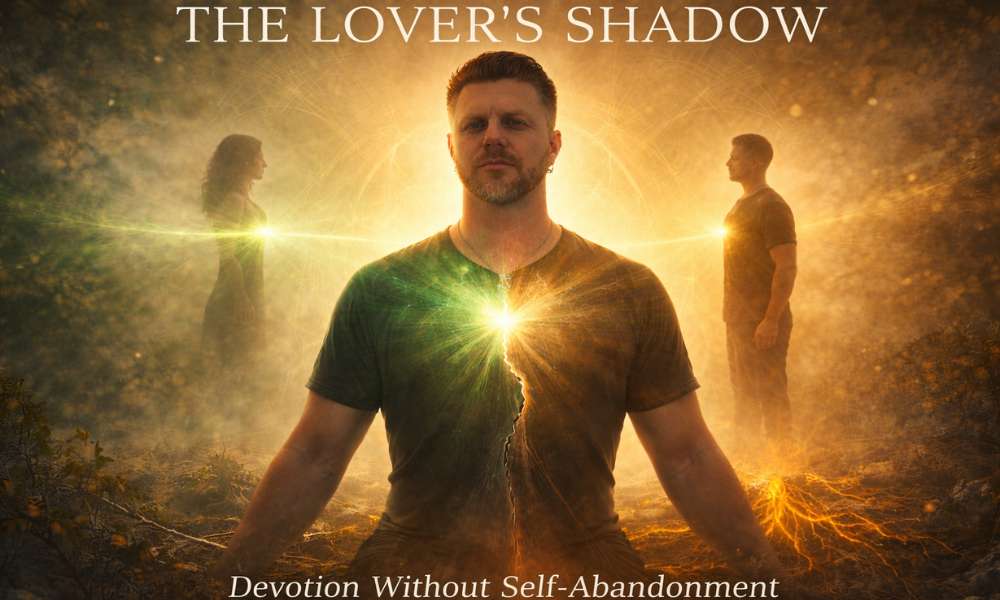
The Lover’s Shadow – When Devotion Becomes Self-Abandonment
I need to tell you about a pattern I’ve only recently been able to name clearly.
For years, I thought I was being “spiritually mature” in relationships. I was:
- Patient when things were unclear
- Understanding when someone needed space
- Willing to work through challenges
- Committed to not abandoning connection prematurely
But underneath that mature response was often something else:
Fear of being alone disguised as devotion.
I would stay in relational dynamics long past their expiration date—not because they were serving me, but because leaving felt like failure. I would over-give, over-process, and over-function, telling myself I was being “the evolved partner.”
But evolution isn’t staying when you should leave.
Evolution is honoring what’s true even when it’s uncomfortable.
This week, we’re facing the Lover’s shadow—the place where devotion curdles into self-abandonment, where openness becomes emotional porousness, and where the desire for union overrides the necessity of sovereignty.
This is hard medicine. But it’s necessary.
The Shadow Side of Venus
Last week we celebrated Venus—beauty, pleasure, connection, the capacity to receive love.
But every archetype has a shadow.
The Lover’s shadow is the Dependent.
When Venus energy is distorted, we become:
- People-pleasers who sacrifice truth for harmony
- Over-givers who resent the imbalance we created
- Codependent partners who lose ourselves in relationship
- Emotionally merged with others in ways that feel like intimacy but are actually enmeshment
The Lover says: “I’m devoted to you.”
The shadow says: “I need you to complete me.”
The Lover says: “I’m open to love.”
The shadow says: “I’ll contort myself to keep you.”
The difference is sovereignty.
The Pattern: Staying Too Long
Here’s a story I’m not proud of, but it’s true:
There was a relationship where, for over a year, I knew something fundamental wasn’t aligned. We had different visions for partnership. Different rhythms. Different needs around space and togetherness.
But instead of naming it and making a clean decision, I:
- Hoped it would change
- Worked harder to “make it work”
- Over-processed every dynamic
- Tried to fix what wasn’t broken—it was just mismatched
From the outside, I looked patient and committed.
From the inside, I was abandoning myself.
I wasn’t staying because of love. I was staying because:
- I didn’t want to be the one who left
- I didn’t want to hurt her
- I didn’t want to admit I’d chosen wrong
- I was afraid of starting over
And all of that is ego, not devotion.
People-Pleasing as Spiritual Bypass
Here’s the subtle trap:
When you’re doing a lot of inner work, it’s easy to confuse emotional maturity with self-abandonment.
You tell yourself:
- “I’m staying open” (when you’re actually just not setting boundaries)
- “I’m being compassionate” (when you’re actually avoiding conflict)
- “I’m honoring the process” (when you’re actually afraid of the outcome)
The spiritual path can become a justification for:
- Not making hard decisions
- Not honoring your needs
- Not trusting your instincts
But spirituality without boundaries is just codependence with better language.
The Father Wound (Again)
This pattern didn’t come from nowhere.
My father was conflict-avoidant. Keeping the peace became his default. He avoided making waves, rarely asserted his needs, and simply endured.
And I learned:
- Good men don’t rock the boat
- Good men sacrifice for others
- Good men stay even when it hurts
What I didn’t learn was:
- Sometimes the most loving thing you can do is leave
- Sometimes saying “no” creates more integrity than saying “yes”
- Sometimes honoring yourself IS honoring the other person
I had to unlearn that staying isn’t always noble.
Sometimes staying is just fear.
Codependence vs. Sacred Union
Let me be clear about the difference:
Codependence looks like:
- I need you to feel whole
- Your emotions determine my state
- I sacrifice my truth to keep you close
- I lose myself in service of “we”
- I can’t tolerate your discomfort, so I fix it
- I need you to validate my worth
Sacred Union looks like:
- I choose you from wholeness, not need
- I can hold my center while feeling you
- I honor my truth even when it creates distance
- “We” is made of two sovereign “I’s”
- I can witness your discomfort without rescuing you
- I know my worth independent of your response
The Lover without the Warrior becomes codependent.
The Warrior without the Lover becomes isolated.
Integration is the marriage of both.
When I Finally Left
When I finally ended that relationship, it wasn’t dramatic.
It was quiet. Clear. Sad.
I told her the truth: “I love you. And I can’t keep pretending this is the right fit.”
No blame. No resentment. Just honesty.
And what I noticed in the aftermath was this:
I felt grief AND relief.
Grief for what we’d built and what we’d hoped for.
Relief that I’d finally honored what was true.
That’s how I know it was the right decision—not because it felt good, but because it felt congruent.
The Current Edge: Trusting My Instincts
Right now, my practice is trusting my instincts earlier.
I used to need overwhelming evidence before I’d honor a gut feeling. I’d wait until something was undeniable before I’d act.
Now I’m learning to trust the whisper before it becomes a scream.
To notice when something feels off—not wrong, not bad, just misaligned—and to name it sooner.
To stop waiting for permission from the other person to honor my own truth.
This is fierce self-love. And it’s hard.
The Tantric Teaching: Devotion to Truth Over Comfort
In Tantra, devotion (bhakti) isn’t blind loyalty.
Devotion is alignment with truth.
The highest form of devotion isn’t staying when you should leave.
The highest form of devotion is acting in integrity even when it costs you.
Sometimes that means:
- Ending a relationship that’s no longer serving both people
- Setting a boundary that creates discomfort
- Saying “no” when everything in you wants to say “yes”
- Choosing your own well-being over someone else’s approval
This isn’t selfish. This is sacred responsibility.
Because when you abandon yourself to keep someone else comfortable, you’re not loving them—you’re using them to avoid your own fear.
The Practice: Reclaiming Sovereignty
Here’s what I’m working with to stay in Lover energy without collapsing into the shadow:
1. The Daily Sovereignty Check-In
Every morning, I ask:
- Where am I over-giving?
- Where am I waiting for permission to honor my truth?
- What am I tolerating that doesn’t serve me?
- What hard conversation am I avoiding?
I write down the answers. I don’t always act immediately. But I stop pretending I don’t know.
2. The Gut-Check Practice
When making decisions in relationship, I place both hands on my belly and ask:
- Does this feel expansive or contracting?
- Am I acting from love or from fear?
- Am I honoring my truth or managing someone’s reaction?
If my belly is tight → I wait.
If my belly is warm and open → I trust it.
3. The “No” as Self-Love Practice
I practice saying “no” to small things to build my capacity for bigger ones:
- “No, I don’t want to go to that event”
- “No, I need alone time tonight”
- “No, I’m not available for that conversation right now”
Each “no” is a vote for self-trust.
Each “no” teaches my system: You’re allowed to have needs.
4. The Grief Release (Again)
Every time I honor my truth, there’s grief.
Grief for:
- The version of the relationship I hoped for
- The person I thought I could be
- The fantasy of “making it work”
I don’t bypass that grief. I let it move through me.
An integrated Lover knows how to grieve what must end.
Integration: The Lover Who Knows When to Walk Away
The mature Lover isn’t someone who never leaves.
The mature Lover is someone who stays in integrity—whether that means staying in relationship or walking away.
He loves deeply. But he doesn’t lose himself.
He commits fully. But he doesn’t abandon his truth.
He honors connection. But he doesn’t betray his sovereignty.
This is devotion without dependence.
This is love without self-abandonment.
And it’s the hardest, most necessary work of the Lover path.
This Week’s Practice: The Sovereignty Meditation
This practice helps you reconnect to your center while staying open-hearted:
- Sit comfortably with your spine straight
- Place one hand on your heart, one on your solar plexus (belly)
- Breathe into your belly first, then your heart
- As you breathe, repeat internally:
- Inhale: “I am whole”
- Exhale: “I am free”
- Notice any resistance, fear, or grief that arises
- Breathe into it without trying to fix it
- Continue for 10 minutes
After the meditation, journal on:
- Where am I abandoning myself to keep someone else comfortable?
- What truth am I avoiding because it might create conflict?
- What would fierce self-love ask of me right now?
Reflection Questions
- Where in your life are you staying too long out of fear rather than love?
- When do you confuse patience with self-abandonment?
- What would it feel like to trust your instincts earlier?
- Who are you protecting by not speaking your truth?
With fierce devotion to truth,
Shiva J
Book a Call with Shiva J: https://api.leadconnectorhq.com/widget/bookings/shivaj

Related Posts



Comments (0)