"The Magician – Mercury and the Moment I Was Seen" takes you on a journey of self-discovery and transformation. Through the symbolic lens of Mercury, it uncovers hidden truths and illuminates the path to personal enlightenment. A powerful tale of unseen moments that shape who we truly are.
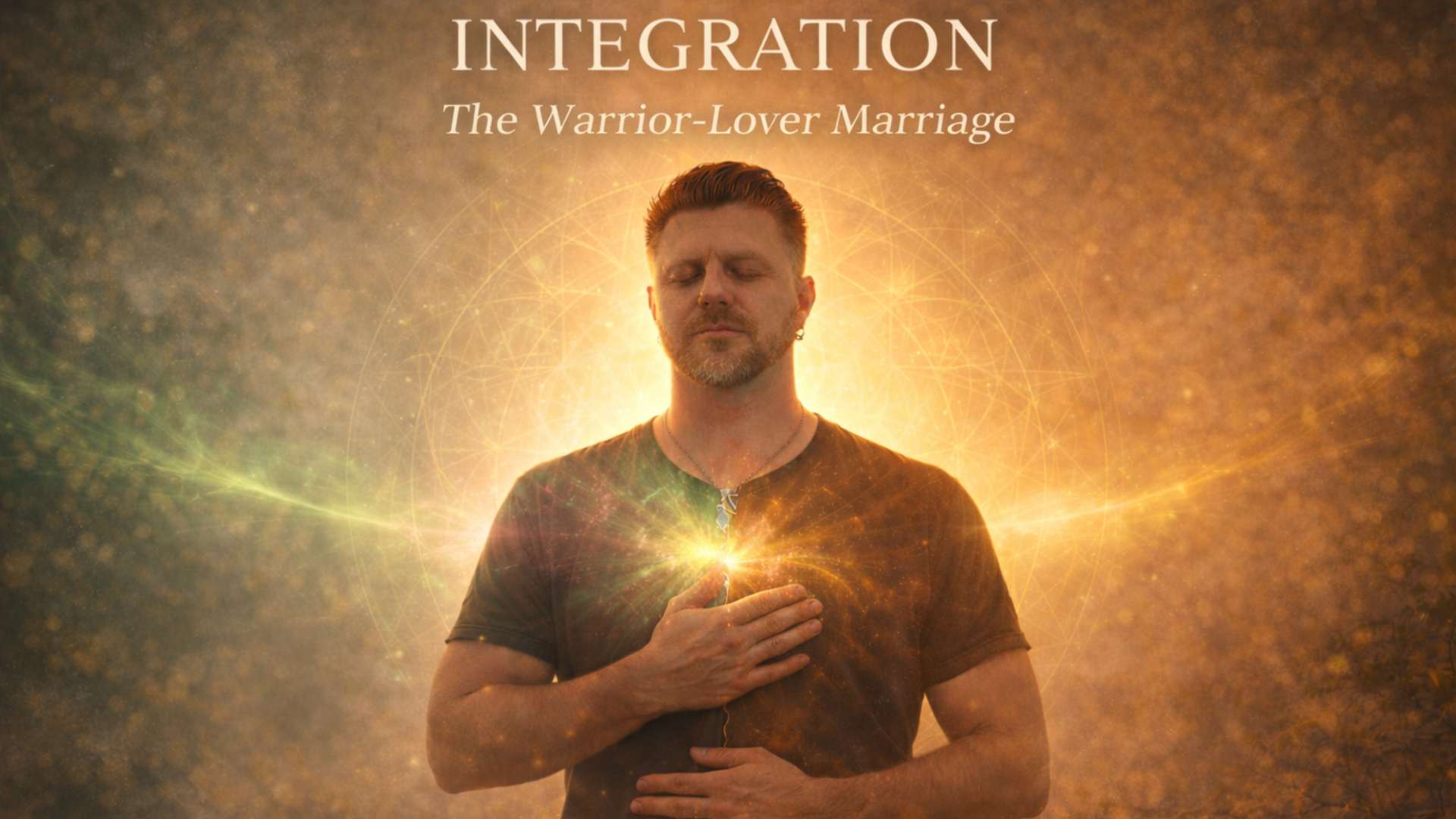
Integration – The Warrior-Lover Marriage
Two months into 2026, and I can feel something shifting.
Not dramatic. Not sudden.
Cellular.
January taught me the Warrior’s path: discipline, action, conscious choice, the fire of will.
February taught me the Lover’s path: beauty, devotion, openness, the art of receiving.
And now, in this final week of the Lover’s month, the real work begins:
Learning to be both at once.
Not alternating between them.
Not choosing one over the other.
But embodying the marriage of Warrior and Lover in the same breath, the same moment, the same body.
This is integration.
And it’s not comfortable.
The Marriage Metaphor
In Tantra, we speak of the union of Shiva and Shakti—the divine masculine and feminine principles that create all of existence.
Shiva is:
- Consciousness
- Stillness
- Structure
- Witnessing presence
- The container
Shakti is:
- Energy
- Movement
- Flow
- Creative power
- The life force
Neither is complete without the other.
Shiva without Shakti is inert—pure potential with no expression.
Shakti without Shiva is chaotic—pure energy with no direction.
When they unite, creation happens.
This is the inner marriage we’re all walking toward—not as a goal to achieve, but as a dynamic balance to practice.
The Warrior is Shiva energy.
The Lover is Shakti energy.
And the integrated man learns to hold both.
What Integration Actually Looks Like
Integration isn’t 50/50 all the time.
It’s knowing which energy is needed in each moment and having access to both.
Sometimes the moment calls for the Warrior:
- Clear boundaries
- Decisive action
- Grounded presence
- Containment
Sometimes the moment calls for the Lover:
- Receptivity
- Softness
- Emotional vulnerability
- Fluidity
And sometimes—most of the time—the moment calls for both:
- Leading with clarity while staying open to feedback
- Setting boundaries while honoring the other’s experience
- Staying grounded while allowing yourself to be moved
- Taking action while remaining attuned to feeling
This is the dance.
My Current Practice: The Internal Check-In
Right now, my integration practice looks like this:
Before any significant interaction—whether with my kids, a partner, a client, or my community—I pause and ask:
“What does this moment need? Warrior or Lover? Structure or flow? Containment or openness?”
And then I listen.
Not to what I think I should do.
Not to what feels safe.
But to what the moment itself is calling for.
Example 1: Parenting
My kids need both.
They need the Warrior who:
- Sets consistent boundaries
- Follows through on consequences
- Creates structure and safety
- Models integrity and discipline
And they need the Lover who:
- Plays without agenda
- Listens without fixing
- Allows emotional messiness
- Shows tenderness and affection
If I only bring the Warrior, they feel controlled.
If I only bring the Lover, they feel unsafe.
Integration means knowing when to be firm and when to be soft—and not confusing the two.
Example 2: Intimate Relationship
The woman I’m seeing right now is teaching me this daily.
Sometimes she needs the Warrior:
- Clear direction
- Grounded presence
- The safety of my certainty
- My capacity to hold tension without collapsing
And sometimes she needs the Lover:
- Softness
- Playfulness
- Emotional vulnerability
- The feeling that she can affect me
If I only bring one, I’m half a man.
The practice is learning to read the field—to feel what the moment is asking for and respond from wholeness, not habit.
Example 3: Teaching and Leadership
In my work, I used to lead primarily from the Warrior:
- Clarity
- Structure
- Boundaries
- Results-oriented
And while that created safety and consistency, it also sometimes felt:
- Rigid
- Performance-focused
- Emotionally distant
Now I’m learning to weave in the Lover:
- Beauty in language
- Emotional attunement
- Spaciousness for process
- Devotion to the person, not just the outcome
The integration is becoming a leader who can hold both rigor and tenderness.
The Tantric Practice: Polarities in Union
Here’s what Tantra taught me that changed everything:
Opposites don’t cancel each other out. They complete each other.
The Warrior isn’t diminished by the Lover—he’s deepened by him.
The Lover isn’t weakened by the Warrior—he’s held by him.
This is why the practice isn’t about choosing one or the other.
The practice is learning to hold the tension between them.
In Tantric practice, we cultivate this through:
1. Breath Work
Warrior breath: Strong, intentional, controlled (like Kapalabhati or Bhastrika)
Lover breath: Soft, flowing, receptive (like gentle belly breathing)
Integration practice: Breathing with both—inhale with strength, exhale with softness.
2. Movement
Warrior movement: Linear, grounded, powerful (like martial arts or strength training)
Lover movement: Circular, fluid, expressive (like dance or free movement)
Integration practice: Moving with both—strong foundation with fluid expression.
3. Voice
Warrior voice: Clear, direct, resonant (speaking from the belly)
Lover voice: Tender, textured, nuanced (speaking from the heart)
Integration practice: Speaking with both—grounded truth delivered with care.
The Shadow of Integration: Spiritual Bypassing
Here’s the trap I’ve seen (and fallen into):
Using “integration” as an excuse to avoid choosing.
Saying “I’m holding both polarities” when really you’re just:
- Avoiding commitment
- Refusing to take a stand
- Using spirituality to bypass accountability
True integration isn’t the absence of choice. It’s the capacity to choose clearly while remaining open to complexity.
Sometimes the Warrior must act decisively—even when the Lover wants to stay open.
Sometimes the Lover must soften—even when the Warrior wants to stay protected.
Integration means trusting yourself to choose in each moment, not waiting for perfect balance before you act.
The Inner Marriage: A Daily Practice
This is the practice I return to every day:
Morning Ritual: Meeting Both
- Warrior practice (20-30 minutes):
- Meditation
- Breathwork (Kapalabhati or Bhastrika)
- Core-based movement or strength training
- Setting clear intentions for the day
- Lover practice (10-15 minutes):
- Gratitude journaling
- Beauty meditation (appreciating something beautiful)
- Soft belly breathing
- Allowing myself to receive the day without agenda
Throughout the Day: The Check-In
Before transitions (meetings, conversations, activities):
- Hand on heart, hand on belly
- Ask: “What does this moment need?”
- Listen
- Act
Evening Ritual: Integration Reflection
Before bed:
- Where did I abandon the Warrior today? (Where did I collapse, avoid, or people-please?)
- Where did I abandon the Lover today? (Where did I become rigid, closed, or controlling?)
- Where did I hold both? (Where did I feel integrated, whole, responsive?)
- What’s one small adjustment for tomorrow?
This isn’t about perfection. It’s about awareness and iteration.
What Integration Feels Like in My Body
When I’m integrated—when I’m holding both Warrior and Lover—I feel:
- Grounded but open
- Clear but curious
- Firm but tender
- Decisive but receptive
My belly is warm and steady (Warrior).
Soft and available is my heart (Lover).
Resonant and nuanced, my voice embodies both.
There’s no collapse. And there’s no rigidity.
There’s just presence informed by wholeness.
The Path Forward: March and Beyond
As we move into March, the journey continues.
The Warrior taught me how to act.
The Lover taught me how to receive.
Now the path is about living as both—not in theory, but in practice.
Relationships benefit from this.
Parenting follows the same idea.
Leadership thrives this way.
It also applies to daily life.
This is the work of 2026: Integration under intimacy.
Not becoming perfect.
Not transcending the human experience.
But showing up whole—Warrior and Lover, structure and flow, consciousness and energy—in service of truth, love, and becoming.
This Week’s Practice: The Shiva-Shakti Meditation
This practice helps you embody both energies simultaneously:
- Sit comfortably with a straight spine (Warrior: structure)
- Soften your belly and heart (Lover: receptivity)
- Bring awareness to your root (base of spine)—this is Shiva, the unmoving witness
- Bring awareness to your tailbone and up the spine—this is Shakti, the rising energy
- Breathe deeply and evenly:
- Inhale: Feel Shakti rising from root to crown (energy ascending)
- Exhale: Feel Shiva descending from crown to root (consciousness stabilizing)
- Hold both in awareness—the rising energy and the descending consciousness meeting in your heart
- Repeat for 10-15 minutes
After the meditation, journal:
- Where in my life am I only accessing Warrior energy?
- Where am I only accessing Lover energy?
- What would it feel like to bring both to [specific situation]?
Reflection Questions
- When do you abandon the Warrior to be liked?
- When do you abandon the Lover to stay safe?
- What would it feel like to be both fierce and tender in the same moment?
- Where in your life is integration calling you forward?
With devotion to wholeness,
Shiva J
Book a Call with Shiva J: https://api.leadconnectorhq.com/widget/bookings/shivaj
Further Reading:
- The Way of the Superior Man by David Deida – Masculine-feminine dynamics (read critically)
- Integral Spirituality by Ken Wilber – On integration across development
- Shakti Mantras by Thomas Ashley-Farrand – Tantric practices for balance
- The Book of Shiva by Namita Gokhale – Mythology and practice
- Tantric Quest by Daniel Odier – Direct transmission of Tantric integration
- The Heart of Yoga by T.K.V. Desikachar – Classical yoga as integration practice
Looking Ahead: March 2026
Next month, we shift our focus to The Magician—the archetype of transformation, mastery, and creative will.
We’ll explore:
- Mercury in Vedic Astrology
- The Throat Chakra (Vishuddha)
- The power of voice and truth-telling
- Alchemy and conscious transformation
The Warrior gave us discipline.
The Lover gave us devotion.
The Magician will teach us how to create reality through conscious speech and action.
Until then, practice the marriage.

Related Posts
Comments (0)